


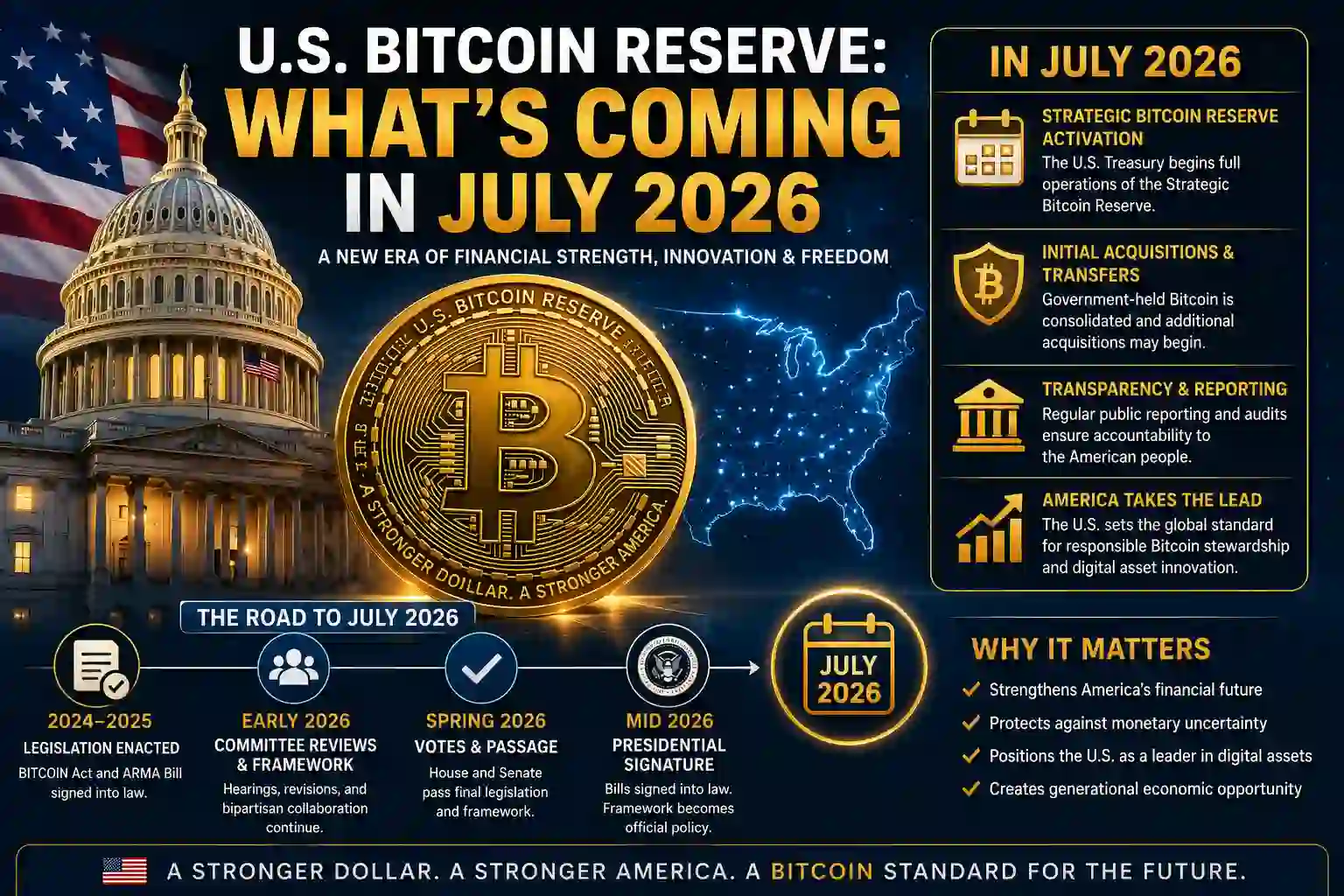
U.S. Bitcoin Reserve: What’s Coming in July 2026
The United States has a Strategic Bitcoin Reserve. It just can’t buy anything. That single gap is the entire story of where U.S. crypto policy stands right now — and July 2026 is when it may finally start to close.
President Trump created the Strategic Bitcoin Reserve by executive order on March 6, 2025. More than a year later, it still holds only seized coins, not a single Bitcoin purchased as deliberate policy. Two competing bills are moving through Congress, a White House blueprint is approaching its one-year mark, and the next few months will determine whether the reserve becomes something real or stays a rebranding exercise.
Here’s exactly where things stand.
What the U.S. Bitcoin Reserve Actually Is
The Strategic Bitcoin Reserve is real. It was established in March 2025 and holds Bitcoin the government acquired through criminal and civil asset forfeiture — coins seized from hackers, fraudsters, and dark web operations. The executive order is clear on one point: none of it can be sold. It must be held as a reserve asset indefinitely.
What the order does not do is authorize the government to buy Bitcoin with public money. It instructed the Treasury and Commerce Secretaries to develop “budget-neutral” acquisition strategies — meaning any purchases must be self-funded through forfeiture proceeds or penalties, with no taxpayer dollars involved.
Treasury Secretary Scott Bessent confirmed the practical reality in August 2025: the U.S. would not be buying additional Bitcoin anytime soon. What exists today is effectively a rebranding of coins the government already happened to hold. Critics were blunt about it. Charles Edwards of Capriole Investments called it “a pig in lipstick” — seized coins with a new name and a promise not to sell, but no real accumulation plan behind them.
The “digital Fort Knox” framing from White House crypto officials ran into an obvious problem: Fort Knox holds gold the U.S. deliberately acquired. The Strategic Bitcoin Reserve holds Bitcoin that used to belong to criminals.
The July 2025 Blueprint: What It Said
On July 30, 2025, the President’s Working Group on Digital Asset Markets released its long-awaited policy report following a 180-day review. The group — led by Treasury Secretary Bessent, Commerce Secretary Howard Lutnick, and SEC Chair Paul Atkins — reaffirmed the hold-don’t-sell policy and the budget-neutral acquisition framework, while pushing for broader crypto reforms across the SEC, CFTC, and Treasury.
The report surfaced one uncomfortable detail: a meaningful chunk of the government’s seized Bitcoin may already be legally earmarked — to compensate fraud victims or flow back into general Treasury funds — rather than sitting freely available for a permanent reserve. That’s why crypto advisor Patrick Witt said the priority was to “get our own house in order” before disclosing the exact size of U.S. holdings.
The blueprint set clear policy direction. What it could not do — because no executive order or working-group report can — is create legal authority to buy Bitcoin. That requires Congress.
BITCOIN Act vs. ARMA: The Two Bills That Would Make It Real
Two pieces of legislation are now competing to define what the U.S. Strategic Bitcoin Reserve actually becomes. They disagree on almost everything.
The BITCOIN Act, championed in the Senate by Cynthia Lummis, is the aggressive version. It originally targeted acquiring one million Bitcoin over time — roughly 5% of Bitcoin’s total fixed supply. If passed, analysts expect the Treasury could make its first official Bitcoin purchase as early as Q4 2026, making the U.S. the first major sovereign nation to deliberately accumulate Bitcoin as a reserve asset rather than simply holding what it seized.
The American Reserve Modernization Act (ARMA), introduced in the House by Nick Begich of Alaska with Democrat Jared Golden of Maine as co-lead, takes a quieter approach. It dropped the one-million-Bitcoin target entirely. In its place: a mandatory 20-year lockup. Any Bitcoin deposited into the reserve cannot be sold, swapped, auctioned, or otherwise touched for at least two decades. The pitch is long-term credibility over aggressive accumulation — a framing designed to bring moderate lawmakers on board.
Begich has said he is coordinating with Lummis to align the two chambers. The final bill, if there is one, will likely be a negotiated blend: somewhere between “buy aggressively now” and “lock up what we have and prove we mean it.”
The Budget-Neutral Rule: The Hidden Constraint
The single most important phrase in this entire debate is “budget-neutral,” and it quietly limits everything.
Both the executive order and every serious legislative proposal require that Bitcoin purchases not draw on appropriated federal funds. Acquisition must be financed through self-funding mechanisms: forfeiture proceeds, penalties, or accounting maneuvers like revaluing the Treasury’s gold certificates at current market prices and using the notional gain.
That’s a genuine constraint on scale. Forfeiture income is irregular and unpredictable. The gold revaluation approach is operationally complex and politically sensitive. Neither source can reliably fund the kind of sustained buying a million-Bitcoin target would require. Even if Congress passes a bill with full purchase authority, real-world accumulation would likely be slow and sporadic — not the steady sovereign bid that Bitcoin bulls are imagining.
The political guardrail that makes the U.S. Strategic Bitcoin Reserve viable is the same one that limits how transformative it can actually be.
How the U.S. Compares to Other Countries’ Bitcoin Holdings
Several governments hold significant Bitcoin, almost entirely through seizure. The U.S. is the only major power to have formally committed to holding it permanently while also pursuing legislation to buy more.
China holds an estimated 190,000 BTC — the largest sovereign stash in the world — with no stated reserve policy. The UK holds roughly 61,000 BTC, largely seized, and has periodically signaled it may sell. El Salvador stands alone as the only government that actively chose to accumulate Bitcoin as policy, holding around 6,174 BTC since adopting it as legal tender in 2021.
If the BITCOIN Act or a comparable bill passes, the U.S. would move from passive holder of seized coins to the first major sovereign actively building a Bitcoin reserve. The strategic case is simple: Bitcoin’s supply is hard-capped at 21 million. Nations that accumulate now lock in a position that latecomers cannot replicate.
What to Realistically Expect in July 2026 and Beyond
Setting aside the rhetoric, here is the honest range of outcomes.
Most likely: incremental progress. More transparency on the size and custody of existing holdings, continued legislative movement on both bills without a final vote, and possibly a refined governance framework for how the reserve is audited and reported.
Bull case: a negotiated bill — blending the BITCOIN Act’s accumulation ambition with ARMA’s bipartisan lockup framing — advances far enough that a first official U.S. Bitcoin purchase in Q4 2026 becomes credible. That would be a genuine historic first for any major sovereign nation, even if the opening amounts are modest.
Bear case: neither bill passes. The reserve stays what it has been since March 2025 — a hold-only stockpile of seized coins with no purchase authority. July produces another policy document instead of a law.
The only thing worth tracking is narrow: does Congress actually grant purchase authority, and through what funding mechanism? A reserve authorized to buy creates new structural demand for a fixed-supply asset. A reserve that can only hold is a symbol. July 2026 will begin to show which one the U.S. Strategic Bitcoin Reserve actually is.