


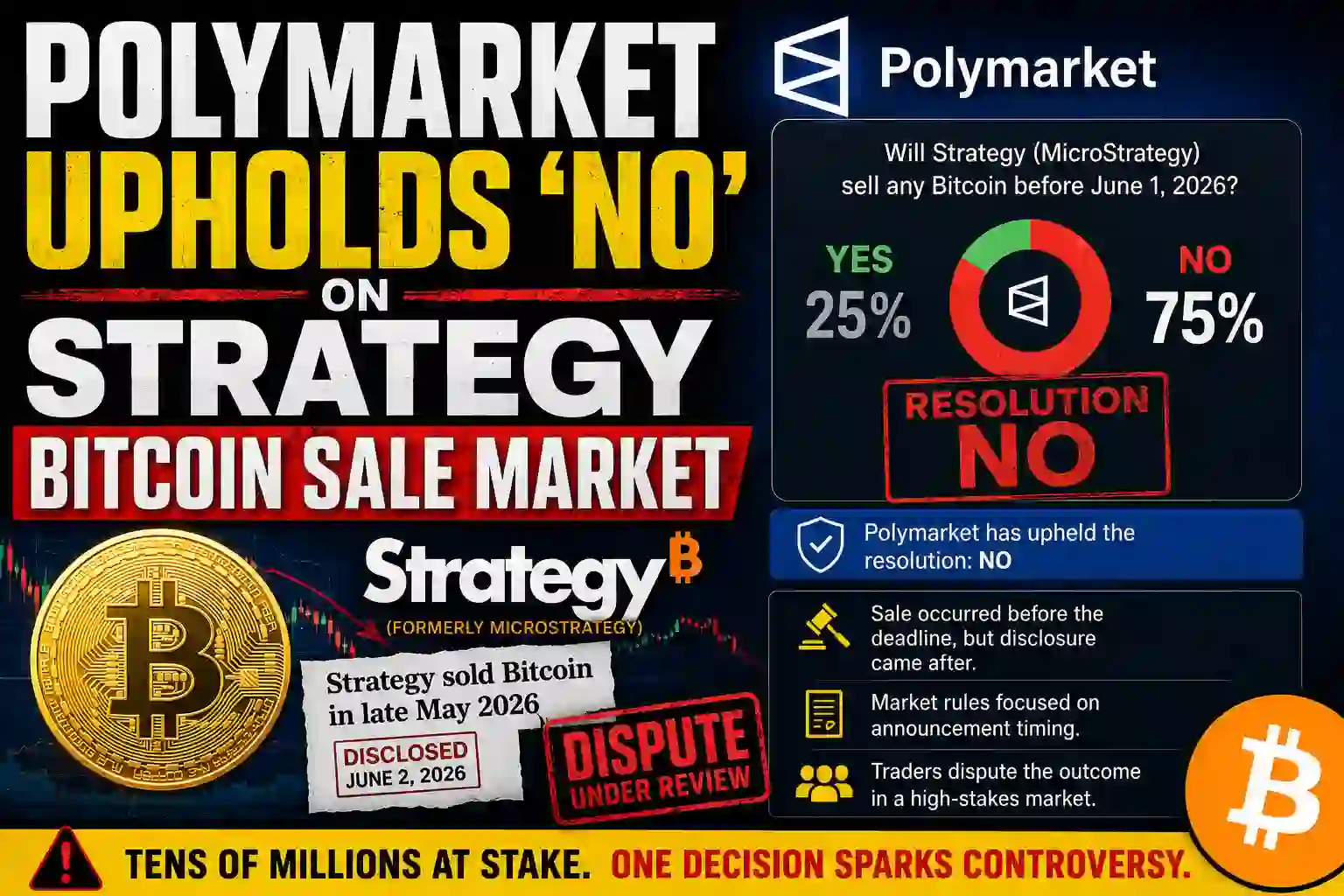
Polymarket Upholds ‘No’ on Strategy Bitcoin Sale Market
Polymarket has finalized one of its most contested prediction markets with a “No” outcome — even though Strategy actually sold Bitcoin before the deadline the market was tracking. The decision has reignited a broader debate about how prediction markets should handle events that happen before a cutoff but only become public after it.
What Happened
The market in question asked whether Strategy would sell any Bitcoin by May 31, 2026. It resolved “No” after 98.6% of UMA voting power backed that outcome in a final review — despite Strategy’s June 1 regulatory filing revealing the company sold 32 BTC for roughly $2.5 million between May 26 and May 31, within the deadline window.
This was the third time the market resolved “No.” Traders who believed the sale qualified pushed back twice, triggering successive challenges before the final UMA review closed the dispute on Wednesday.
The crux of the disagreement: did the sale happen before the deadline? Yes. Was it publicly confirmed before the deadline? No. Polymarket added a note to the market page during the dispute stating that “confirmation achieved outside of the market’s time frame does not qualify” — a clarification that became the deciding factor in the final ruling.
Traders Say the Goalposts Moved
Several traders who held “Yes” positions criticized the outcome publicly, arguing the post-trade clarification changed the rules after real money had already been placed.
Trader 0xDinosaur, who disclosed purchasing 49,695.76 “Yes” shares for roughly 35,000 USDC, argued before the final ruling that the contract asked whether Strategy sold Bitcoin by May 31 — with no requirement that the sale be publicly disclosed before that date. “Risk-taking does not change the facts, and it does not allow a platform to apply an unclear or unwritten rule after real money has already been placed,” he wrote on X.
Trader willo2 claimed to have lost $500,000 after placing large “Yes” positions on June 1, alleging the market stayed open for betting after information about the sale had already emerged. His take on the outcome was blunter: “Even if UMA voters think that this outcome is ridiculous… they are forced to ratify it. Polymarket changed the rules, and now the outcome is literally in the rules.”
Why This Goes Beyond One Market
Galaxy Research framed the dispute as a question about which set of rules should govern — the original event-based framing or the post-trade confirmation-based clarification Polymarket introduced mid-dispute.
“Traders correctly predicted the future. The platform is about to tell them they were wrong anyway,” Galaxy Research wrote on X. The firm argued prediction markets should resolve based on what actually happened, not on how an oracle reinterprets rules after the fact. It called for clearer listing criteria, deterministic resolution methods for verifiable events, and structural reforms ahead of potential regulatory scrutiny.
The Strategy filing itself added context that sharpened the debate: the company sold 32 BTC while still holding 843,706 BTC as of May 31, with proceeds earmarked to support preferred stock distributions. The sale was real, small relative to Strategy’s holdings, and disclosed one day after the deadline — which is precisely what made this case such a clean stress test for prediction market resolution standards.
The Bigger Question
The Polymarket ruling is final. But the question it leaves open is not: when an event occurs before a deadline but is confirmed after it, which fact governs the outcome? How platforms answer that question — and whether they answer it before trading opens rather than mid-dispute — will matter a great deal as prediction markets attract more capital and, potentially, more regulatory attention.